Taralee Guild · Painter · Currently at JG Art Gallery
Taralee Guild was born in 1984 in Thunder Bay, Ontario. At twelve she inherited her Grandma Ethel’s paint box and easel and began painting — an impromptu still life session that turned into a lifelong practice. She moved west and graduated from Emily Carr University of Art and Design with a BFA in Visual Arts in 2010, bringing to her self-taught passion a grounding in art history and critical theory. She works full time from her studio in Vancouver. Her work has been collected internationally, in private and public collections. She works on several series simultaneously, each with its own ideological context.
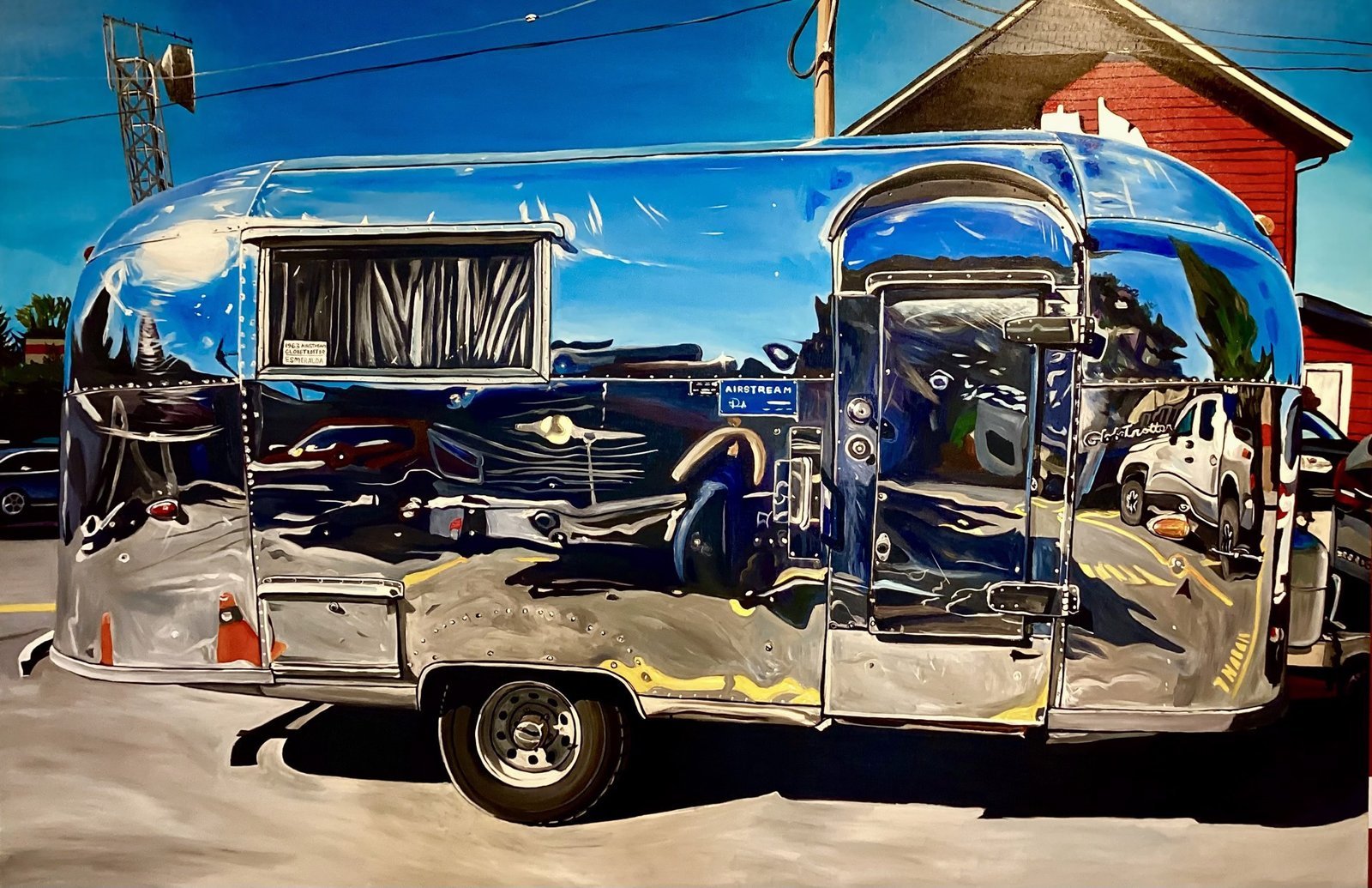
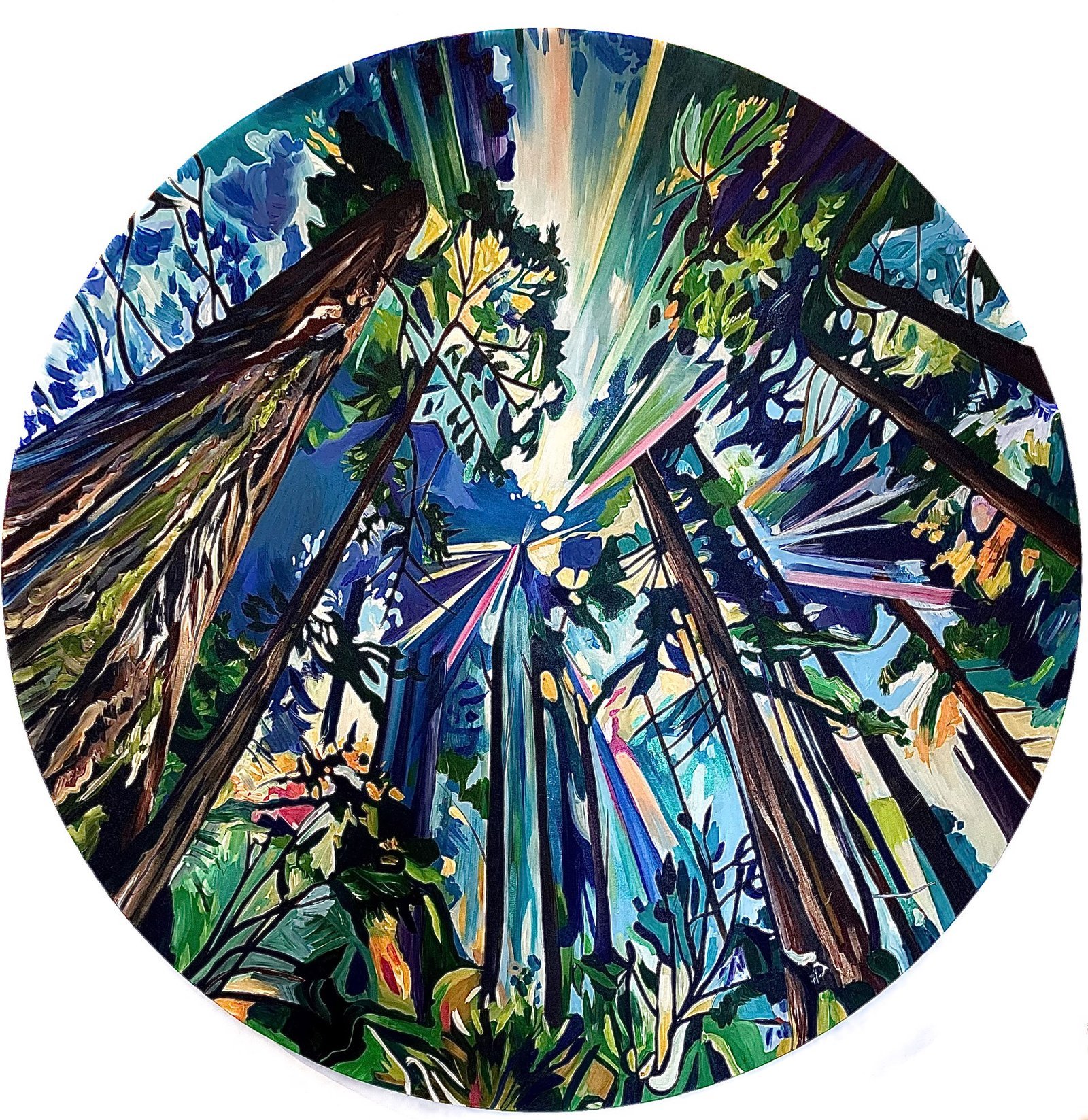
The two series for which she is best known are formally opposite and philosophically connected. The Airstreams paintings are hyper-realist studies of mid-century aluminum trailers — Spartanettes, Airstreams, Westfalias — painted from photographs she takes at vintage trailer rallies, traveling as far as Pismo Beach, California to find the right subjects. The appeal is not nostalgia. She reads the reflective metal through Bataillean Surrealism: the aluminum skin becomes an arena for animal mimicry, doubled imagery, and formlessness — the trailer hides in its surroundings the way camouflage hides an animal, and the distorted reflection is simultaneously a precise record of the surrounding landscape and something hallucinatory and unrecognizable. Because she photographs the trailers herself, each reflection is technically a self-portrait, though the figure that appears is faceless, elongated, and operating from a disembodied vantage point. The Nature’s Cathedral series is the other pole. Guild traces the concept to reading Raymond Carver’s short story “Cathedral” — in which a man cannot describe a cathedral to a blind person and then loses himself in an overwhelming feeling — and then standing before Rothko’s No. 16, 1957 at the National Gallery, where she had the same experience. Old-growth BC forests, she realized, generate the same effect as cathedral interiors: natural light, expanding vertical space, and transparent color create what she calls dematerialization — the structure of the space becomes intangible, less important than the experience of it. The compositions spiral from photographic accuracy into abstraction, referencing West Coast First Nations design. She works from photographs taken in Stanley Park and Cathedral Grove. In Downtown Tofino Airstream, The trailer's curved aluminum skin warps the red beach house, utility poles, and cloudless sky into elongated, compressed bands of crimson, electric blue, and bleached white—a funhouse mirror that registers landscape as pure surface distortion rather than coherent space. The reflections flatten depth: the distant mountains and parked vehicles compress into graphic smears across the metal body, where the horizon line bends upward in a parabolic curve that defies atmospheric perspective. What emerges is not a faithful record of place but a catalogue of optical impossibilities, where the trailer's geometry overwrites the actual surroundings, collapsing illusionistic space into the declarative flatness of the object itself. In Sleepy Spartanettes, The polished aluminum skin functions as a funhouse mirror that fractures the campground into competing color zones—the sky bleeds cobalt into the trailer's curve while trees compress into dark striations, and the red bicycles splinter into abstract vermillion streaks that barely cohere as recognizable objects. Guild's brushwork on the metal surface reveals how realism fundamentally breaks down under reflection; the chrome becomes a membrane where the landscape doesn't sit behind glass but dissolves into it, erasing the distinction between the trailer's body and the world it mirrors. The painting argues that nostalgia for mid-century Americana isn't about preserving clean lines or stable identity, but rather acknowledging how badly distorted our fantasies about that era have become. In The Path Along Duck Creek, The painting collapses the forest floor into a compressed plane of writhing greens and blacks while the canopy explodes overhead in yellows, blues, and oranges that seem to vibrate against one another rather than recede—a spatial contradiction that forces the viewer to process two competing depths simultaneously. Light doesn't filter down so much as detonate across the upper third, fragmenting into hot streaks of cadmium and cerulean that bear no relationship to how sunlight actually moves through old growth, suggesting instead an internal emotional register mapped onto the landscape. The work argues that representation of nature requires distortion: that fidelity to the actual forest demands we abandon fidelity to optical realism, collapsing the Romantic sublime into something closer to visual noise.
I find more random, stranger, and unknown imagery through strictly following my photographs than if I invented it. Unlike photography, if composed from my mind, I’ll inadvertently organize elements and make something expected. Old growth forests are like cathedral interiors — both use a combination of natural light, expanding space, and shimmering colour to create a feeling of elation and dematerialization in the viewer.
Taralee's practice, in detail.
Education & Formation
- 1984Born Thunder Bay, Ontario
- Age 12Inherited Grandma Ethel's paint box and easelFirst still life — beginning of lifelong painting practice
- 2010BFA Visual Arts — Emily Carr University of Art and DesignVancouver, BC
- StudioFull-time painter — Vancouver, British Columbia
The Airstreams Series
- SubjectMid-century aluminum trailers — Airstreams, Spartanettes, WestfaliasPhotographs taken at vintage trailer rallies; travels to Pismo Beach CA
- TheoryBataillean Surrealism — animal mimicry, doubled imagery, formlessnessTrailer hides in surroundings through reflection — camouflage logic
- Self-portraitEach reflection is a micro self-portrait — faceless, elongated, disembodiedDistorted fun-house mirror: "an odd disembodied gaze"
- LineagePost-WWII aerodynamics — Art Deco design — PrimitivismHyper-realism that collapses into the hallucinatory
Nature’s Cathedral Series
- OriginRaymond Carver's story "Cathedral" (1983)Man cannot describe a cathedral to a blind person — then loses himself in overwhelming feeling
- EpiphanyRothko's No. 16, 1957 — National GallerySame dematerialization as cathedral architecture — structure becomes intangible
- SubjectBC old-growth forest canopies — Stanley Park — Cathedral GrovePhotographed from below — vertical expansion of light, space, colour
- LineageEmily Carr — Lawren Harris — Group of Seven — Gordon SmithCompositions spiral into abstraction referencing West Coast First Nations design
Collections & Record
- CollectionsInternational private and public collections
- GalleriesJG Art Gallery — Bainbridge Island & Park CityMayberry Fine Art — Winnipeg
- SoldWork on Artsy — sold through JGO Galleries Park City + Bainbridge Island
Critical Context
- Hyper-realismStrictly follows photographs — finds stranger imagery than invention allowsRandomness of the real exceeds what the mind organizes
- DematerializationOld-growth forest as cathedral — light + space + transparent colourHagia Sophia (Istanbul) cited as the architectural model of the phenomenon
- SurrealismFormlessness, camouflage, the uncanny in domestic/suburban objectsMundane setting made frightening by imaginary space in the reflection
Works at JG
- Range12 works — Airstreams and Nature’s CathedralSkyward Apparitions · Sleepy Spartanettes · Downtown Tofino Airstream · Paris Cathedral · Duck Creek
As featured in.
Selected works.
A current selection from Taralee's work, available through JG Art Gallery. The gallery responds within one business day with placement, dimensions, and indicated price for the work in question.
The gallery responds within one business day.
For current availability, pricing, or to commission new work, write directly. Worldwide shipping, payment plans, full provenance documentation.